Green Kids like going green

How to Get Kids Involved in Being Green

In recent years, many of us have shifted into living a greener life. We’ve become more aware of turning off lights when we leave a room, have switched to using reusable grocery bags, and have started sorting trash from recyclables before throwing things out. However if we want to continue to further the green movement we can’t stop there. We have to get our kids involved in living a greener life too; otherwise our efforts will eventually stall out. To help get your kids involved and interested in the green movement, try these tactics:

  1. Make it a challenge. Kids love to compete against other people, so make going green a challenge. See who can collect the most recyclables throughout the week and give everyone a different bin to put their recycling in. Assign different people in the house different green chores, like making sure all the lights are turned off before bedtime or collecting cans around the neighborhood, and keep track of who is the most consistent at accomplishing their tasks. At the end of each week award a prize to who did the best job, like letting them pick the movie to watch on movie night or taking the family to the winner’s favorite restaurant for a meal.
  2. Make it fun. Not all recyclables have to be taken to the recycling bin; instead make craft projects out of old toilet paper and paper towel tubes, or artwork out of scrap paper. Have the kids make papier-mâché robots from the tubes and cereal boxes, or paint pictures over paper that’s been written on. Show them how easy it is to re-purpose recyclable items instead of throwing them away.
  3. Plant a produce garden together. To teach kids the importance of eating locally grown, organic foods, plant a garden together. They’ll love spending time outside working in the dirt alongside you, and how often do we really encourage them to get their hands dirty? They’ll learn about gardening and biology in the process, and they’ll be proud when they harvest their produce or herbs.
  4. Talk to them about the importance of going green. Kids are like sponges when it comes to absorbing information, so talk to them regularly about how important it is to our planet to live a green lifestyle. Explain how we’re hurting our planet, how we can help, and why everyone needs to pitch in. They’ll probably end up retaining a lot more information than you think.
  5. Involve them in your green efforts. When you need to take the recycling to the recycling plant, take the kids with you. Have them help you sort through trash and recyclables together. Make a game out of crushing cans. Show them how they can pick up trash around the neighborhood to help keep everything clean and beautiful.

By actively living a green lifestyle and encouraging our children to do the same we can make a lasting difference in the preservation of our planet. Don’t assume that kids are too young to be involved; instead teach them from early on how they can make a difference. It’s through the generations to come that we can help clean up and preserve our planet, and every little bit helps.

About the Author:


This guest post is contributed by Debra Johnson, blogger and editor ofLiveinnanny.comShe welcomes your comments at her email Id: jdebra84 @ gmail.com.


Eco-houses are on their way


Construction of environmentally friendly houses is a new trend in modern architecture, which benefits both to art and energy efficiency. Multiple definitions might be provided to enclose main purposes and peculiarities of such housebuilding, but the prime idea is finding a way to live in harmony with nature. To give some details, there are some requirements if to construct an eco-house.

Firstly, it should be made of local materials, which are low-cost in the context of production, processing, transportation methods and letting to apply the house building technology without heavy equipment. In this way, after accomplishment of exploit period the materials used might be utilized just on the site. Small financial expenses facilitate the availability of ecohouses to the majority of people. Secondly, energy efficiency systems contribute to living in a harmony with surrounding environment. In particular, they include solar panels embedded on the roofs, small wind turbines, geothermal power generators, etc. Thirdly, residence in ecohouses stipulates the engagement in essential biointensive technologies usage, which emphasizes processing and recycling of organic wastes and improvement of soil fertility. In the majority of cases it is associated with agricultural activity featuring cultivation of compost plants and organic farming. Ecohouse must ensure the accumulation of environmental resource area, on which it is built.

There are several magnificent examples of ecohouse building, which alert an attention by brave ideas and original construction. One of the recent advancements is observed in Peking, where this architect trend is performed not by single house, but the whole apartment complex. To be more précised, Linked Hybrid (the project name) is based on the geothermal power generators: the heating is provided by 660 geothermal springs located on the 100-meter depth. The entire complex consists of 8 linked buildings, maintaining 750 apartments, cinema, school, hotel, sport facilities and department stores. The total area is 220 thousand square meters. The other green technologies, embedded in Linked Hybrid Project, are recirculation of water and greenery on roofs. Hence, ecohouse building involves not only separate suburban houses, but the apartment complexes in the hearts of urban living nowadays.

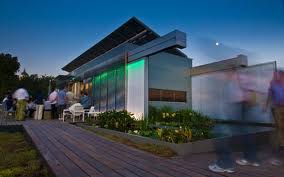
It is also appropriate to name the best example of ecohouse construction in the world. Lumenhaus in the United States is a true reflection of scientific breakthrough and exquisite architect style. The achievements of Lumanhaus include low cost, simplicity and, of course, energy efficiency. The energy support of the building is ensured by 45 solar panels, implemented on the rooftop and along the perimeter (the total area is 72 square meters). The architect merits were estimated from the point of ergonomics: the house is opened and spacious enough to change a room configuration in correspondence to owner’s preference.

Notwithstanding architect art engagement, ecohouses appear to be systems with positive ecological resource. Therefore, their main value is in establishing a compromise with nature and further improvement of human-environment relationship.

This has been a guest post by Maria Kruk, an author for Patentsbase.com

Sky Farms

Sky farms – The new Green farm?

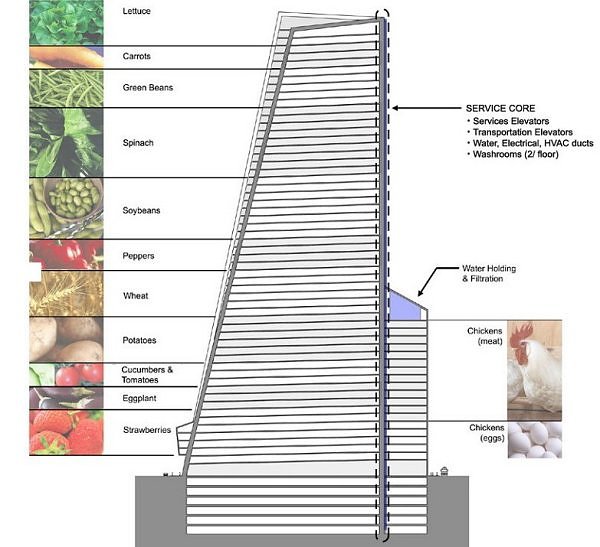
Sky farms are quite literally multilevel agricultural farms, much like
skyscrapers. These sky farms are springing up all over the world, and the
economics of sky farming are already showing positive results. Sky farming
is basically a form of hydroponic farming. It includes significant potential for
organic farming, and major improvements in water usage efficiency. Sky farms
to involve some logistics and infrastructure, notably provision of in-house water
management systems and electrical services, but these are actually far more
economic than traditional agricultural systems.

Sky farm basics

Sky farms are essentially high-rise buildings. They’re designed to achieve
maximum efficiency in the growth and harvesting of agricultural products of all
kinds.  They’ve already shown significant potential for commercial production.
Many growers are particularly interested in the fact that sky farms also provide
enclosed spaces, which naturally provide significant protection against the
elements, weeds, droughts and insect and fungal pests.

Sky farms and agricultural issues

Because sky farms provide a lot of vertical and cubic space, they can overcome
the limitations of the “two-dimensional” traditional farming environment. It’s
possible that the sky farms may be the solution to the increasing problems
of conflicting land use where urban land is displacing agricultural land and
agricultural land is destroying natural habitat and ecology.

The appalling condition of rural land around the world is a major issue
currently being raised at government and international levels regarding the
sustainability of future food production. Sky farms have the potential to
completely eliminate this problem. Theoretically they can grow more food in
far less space than traditional farming.

The economics of traditional rural land use can also be drastically improved by
sky farming. The fact is that it takes extraordinary amounts of water and soil to
produce basic agricultural products. That situation is definitely not sustainable,
and far more efficient means of food production are desperately required.

Because of the quasi-hydroponic nature of sky farming, water usage can be
improved by up to 200%. Soil degradation can be drastically decreased, due to
the fact that sky farm plants use significantly less soil in their growth media.

Organic growers concerned about the possibility of contamination and cross
pollination of their crops with genetically modified organisms have also
expressed interest in sky farms, which provide enclosed growing habitats for
their products. Sky farming could in fact be a particularly useful method of
ensuring agricultural and botanic genetic lines.

The future of sky farming

The big winners in sky farming will be farmers, consumers and the
environment. Sky farms have so far shown themselves to be very easy to
manage, logistically simpler to operate in terms of crop management, and to
have the potential for significant flexibility in choice of commercial crops.

It may be strange for a while for farmers when they realize that instead
of using a backhoe they’ll have to call an electrician, but the cost savings
and peace of mind may be the greatest breakthrough for farmers since the
Agricultural Revolution.

Sky farming is a very much more efficient, profitable approach to a serious
food supply situation which traditional commercial farming has so far shown
itself to be completely unable to address.

The Benefit of ceiling fans

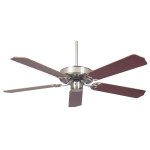
Hugger style ceiling fans can save you a lot of money normally spent on air conditioning.

It is not just about have air blowing on you to keep cool, it is also very helpful when used in conjunction with an air conditioner to quickly and efficiently cool your house.

Keep cool and save money this summer with great deals!

click here to find fans in Hollywood, CA

LED part two

A while back I wrote a post on how LEDs might suck because my personal experience with them has been bad.

Well I’ve done the research and it seems clear that all lighting will eventually be LED lighting.  My father just built a house lighted entirely with LEDs and his electric bill is ridiculously low. The problem at the moment is that there are a lot of poor quality LEDs coming out of places like China.

It is also very difficult to tell quality from crap just by looking so I would go by price. An LED bulb with room lighting capabilities will be about 3-4 dollars apeice.   The investement is worth it for the lower electric bill plus you won’t have to change bulbs for more than ten years.

I reccomend Cree Lighting Products, particularly their xlamp series.

Edison’s incandescent bulbs take standard 60 watts

Compact flouesent take maybe half that about 20-30 watts

For the same amout of white light emitted (lumens) an LED takes 5-10 watts

led-light-bulb

LED lights, Theory vs Practice

LED technology is the current favorite for lighting in the future. They use less energy than fluorescent lights and can emit more pleasing light.  They also in theory do not need to be replaced for many years.

I worked at a hardware and furniture store when I was in college and we carried many different LED desk lamps over the years.  That experience showed me that LED light bulbs break all the time and are often very difficult to replace.

Now it is certainly possible that these were cheap lights not on par with the LEDs of today but given the simple construction of the diode, I don’t think it should matter.

I understand why in theory these light would last longer, IE there is no filament to burn out etc.   So are some types just better than others?

led

Steel Insulated Panels

 current-proj-image

My father is building a house in Mass out of steel. The walls are made of super insulated steel panels supported by a steel fram and jointed with foam.

He was a little delayed in getting the heating system going but apparently all he need is four space heaters to heat a five thousand suare foot house to 60 degrres while it is -2 F outside.

This was amazing to me because I used to spend enormous amounts of money on oil heat and space heaters and I was still not that warm. 

Here is some general info about these panels: PATH Case Study

Here is the blog on the steel house: Strategy to Design