


Filed under: Global Warming | Tagged: Global Warming, greenhouse effect | Leave a comment »


 Environmental Graffiti Grist Future news Business Week ZD Net Green Options Renewable Energy News
Filed under: Global Warming | Tagged: Global Warming, greenhouse effect | Leave a comment »
White reflects and black absorbs.
It’s a simple statement with massive ramifications if our society decides to use the science of color to fight global warming. For centuries cities in places like North Africa and the Mediterranean have been painting everything bright white to keep cool. White reflects the heat radiation back into space while darker colors absorb heat radiation and would therefore increase the temperature in and around the house.

Why did we abandon this simple technique that seems like a no brainer in places like Los Angeles? The answer is that it is much cheaper to use dark building materials. Asphalt and tar are two of the most ubiquitous building materials we use to construct cities and roads. The detrimental effect of building like that is referred to as the “Urban Heat Island” effect. This is why cities are generally much hotter than the surrounding countryside.
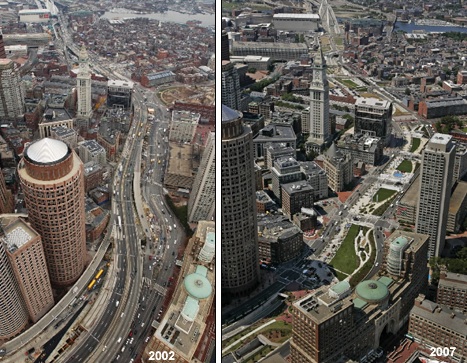
In cities with ample precipitation, the best solution involves plants on places like rooftops and vacant lots. The city of Boston buried it’s largest highway and built a giant park in it’s place. The “Big Dig” was a disaster as far as construction projects go but the original concept was great. (When I was ten years old, the Major of Boston told me the Big Dig would be done in five years…I am now thirty and they just finished.)
The problem with this approach in Los Angeles is the complete lack of rain. No one should be watering large lawns because it’s just downright irresponsible. Replacing lawns with fake grass actually contributes to the Urban Heat Island and also destroys whatever ecosystem existed there before. Residents of Los Angeles can enroll in a rebate turf removal program whereby you replace the grass with drought resistant plants and get money back from the city.


Of course if you can’t get people to vaccinate their children, the concept of deadly irresponsibility may not be salient for the residents of greater Los Angeles.
If you want to be a responsable member of society, however, paint white and tear up all that thirsty grass.
Filed under: conservation, Energy, Environment, garden, People, Philosphy, Science, Urban Heat Island, Water | Tagged: Conservation, Efficiency, Global Warming, history, Water | 1 Comment »
How Realistic is Ocean Front Property in Arizona?
Due to the melting of the polar caps and the various land-based glaciers all over the world, many islands across the globe are in jeopardy of being submerged. This isn’t a “could happen” scenario as Indonesia has already lost more than 20 of its 1500 islands since 2005. It is also projected that the Maldives will be nothing more than a tropical memory by 2050. As these levels continue to rise, could there really be ocean-front property in Arizona within the next century?
Elevation Matters – Arizona’s mean altitude is 4100 feet above sea level. According to NOAA, the National Oceanic and Atmospheric Administration, the levels have been rising at 0.12 inches per year since 1992. However, it has been reported that this has been a 50-percent increase since the recorded levels of the early 1900s. If the sea levels were to continue at just over one-tenth of an inch per year, it would take 410,000 years in order to submerge Arizona. That also is based on a formula assuming that there is no further increase.
Compounded Problems – At the current rate of melting, NOAA is predicting that the water levels will actually rise by six and one-half feet by 2100. This is a calculation based on the exponential rise of the levels over a period of time. This means that the water will rise approximately 83-percent faster than the 0.12 inches per year as stated above. At that rate, Arizona could become a shore-line state in 69,700 years – plenty of time to pack your sunscreen and surfboard.
Melting Polar Caps – When you see an iceberg in the ocean, it may not look very intimidating at first. When you realize that most of these chunks of ice hide 80-percent of their mass underwater, then you can get a better idea of how large they truly are. This inspires the term, “only the tip of the iceberg.” Although this mass displaces the ocean water around it, it’s also fresh water that is contained within those behemoths. When you consider how much ice was at the North and South poles of this planet that is an incredible amount of fresh water being added to the oceans. This doesn’t include the ancient glaciers that are land-based such as those found in Peru, Alaska and Canada.
Fresh Water Induction – Added large amounts of fresh water to the ocean causes changes in how the currents react. In the movie, “The Day After Tomorrow,” this caused massive storms to populate in a matter of days. In reality, that scenario isn’t far from the truth. According to RealClimate.org, there is scientific evidence to support that the Gulf Stream currents have been reduced by 30-percent. These oceanic streams assist in the weather patterns that can be felt globally. This isn’t including the fact that fresh water puts strain on fish and plant life including decreasing overall buoyancy.
Human Made or Natural Evolution? – There is great debate about the ice-melt as being human made or just natural evolution of the planet. We have scientific evidence that can provide stability for either argument. Scientific discoveries have shown humanity that there have been as many as five ice ages in the past 2.4 billion years. Every two to three hundred million years, the conditions are ripe for the planet to essentially freeze itself. Could the melting of the global ice sheets contribute to hastening our next ultimate winter by altering the weather patterns?
Currently, Arizona is safe from becoming a port city. Although the rising sea levels could displace more than 180,000 families by the end of the century, the state’s sheer altitude provides a great deal of protection. As long as the San Andreas doesn’t snap and sink California, Arizona residents won’t have to worry about donning flood pants.
Ken Myers is a father, husband, and entrepreneur. He has combined his passion for helping families find in-home care with his experience to build a business. Learn more about him by visiting @KenneyMyers on Twitter.
Filed under: Environment, Global Warming, Green Building, News, People, Water, Weather | Tagged: Conservation, Global Warming, greenhouse effect, Oceans, Scientific Studies | Leave a comment »

Guest post by Maria Kruk, an author for Species.com
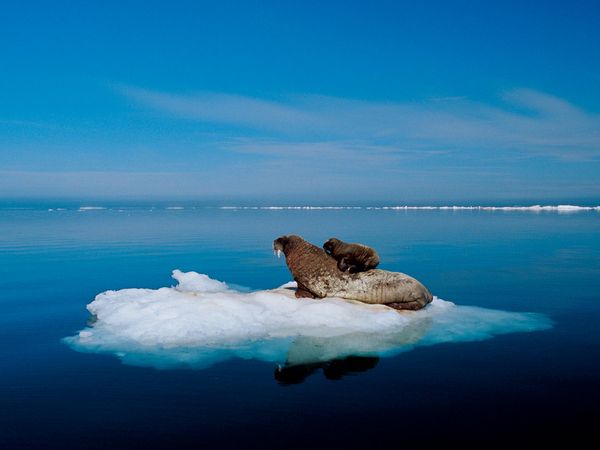
Global awareness of climate change is obvious. The atmosphere is full of greenhouse gases, hurricanes and storms “attack” more regularly, sea level shifts proportionally to ice melting and more species are getting vulnerable and endangered. Specifically, animal world might experience severe damages in the nearest decades and polar bears, which have already recognized the most threatened because of the Arctic Meltdown, might be not the only victims of global warming process.
Filed under: Environment, Global Warming | Tagged: Animals, Conservation, Global Warming, greenhouse effect, Oceans | 3 Comments »
Going Green in Small Things
When we think of going green we typically think of things like adding solar panels to your home’s roof or massive wind farms or building a home out of used tires. However, going green does not have to mean making massive, expensive changes to your lifestyle. You can just do a few little things and make a big impact on the environment. Here are some little things you can change –
All these little steps add up to really help the environment. Remember that you do not have to be rich to be green. Just a few thoughtful changes and a little effort on your part can help us to keep the Earth in shape for the next generation.
Author Bio:
Jason Miner plays a vital role for www.blogcarnival.com. He is an expert in writing topics of different categories. He is helping the carnival team to grow & working on making this an even better place for bloggers.
Filed under: Energy, Environment, Global Warming, Green Building, People, Philosphy | Tagged: Conservation, Education, Efficiency, Global Warming, LED, lighting, Pollution | Leave a comment »

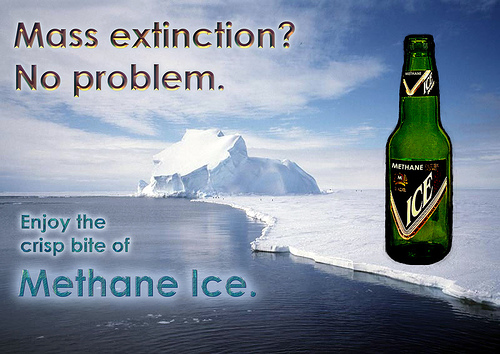
A while back I wrote a post HERE and HERE on collecting natural gas hydrates from the sea floor. I was not really in favor of the idea because of the possible/probable dangers. For good or bad like drilling at 5000ft for oil, extracting these frozen naturals gasses is going to happen so might as well examine the effects..
One of the often cited problems with natural gas as an energy source is that they are hard to safety transport over long distances because of the volatile and hazardous properties of the fuels. A proposed solution is to turn the fuel back into a solid by freezing and applying pressure like at the bottom of the ocean where fuels like methane are in a solid and thus more stable state.
My concern in using this method of freezing and unfreezing is how much energy will be needed to convert a gas like methane into a solid. The melting point of methane is about -297 F(162.5C) so an extremely cold environment would be need to convert and keep methane as a solid. The other problem is that natural gas is another limited resource so putting lots of energy into collecting it is not a good long term energy strategy.
However, just like coal and oil, we will take natural gas as long as we can get it and so having a viable fuel transportation strategy is an important development.
Filed under: Energy, Environment, News, Science | Tagged: Global Warming, Nateral Gas, Natural Gas, Oceans, Public Policy | 1 Comment »
350.org
A friend of mine made this video and I think it is a good way to get people’s attention…clearly we need a new approach to get people to take climate change seriously.
The production was done very well and Bill O’Reilly doesn’t like it so that’s a good sign.
Filed under: Environment, Global Warming, News | Tagged: Conservation, Global Warming | 1 Comment »
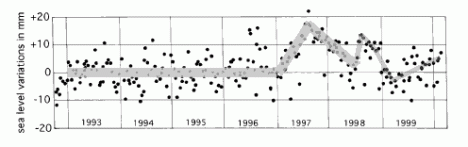
I got some harsh feedback from the last post, particularly because of the idea that sea levels are not rising. The UN hired some scientists to research levels rising and when they found no positive results they were fired and replaced with scientists who found results more in line with the rest of the report.
don’t overestimate our knowledge of the global climate, particularly it’s influences and reactions, very little about the climate is intuitive
the earth is on a much larger time scale, we have existed for the smallest fraction of time and may not be as powerful as we think…I hope not. Take a look at scenarios showing t what would happen if humans disappeared instantly.
The tides are mysterious, oddly enough in the 19th century we had the tides down to the minute but that’s a secret lost in the modern age. Perhaps this is because it isn’t necessary to sail on the tides anymore, I’ve had to do that when a motor broke and it’s quite a pain in the ass.
-we know more about the moon than the ocean
–this is not a reason to think emissions and pollution are not dangerous
at this point all sides of the political debate are throwing out a lot of BS…lots of spin on both sides.
find the studies by Dr. Nils-Axel Mörner, he’s an expert in the field despite the slander of fools.

Filed under: Business, Environment, Global Warming, Science | Tagged: Global Warming, Oceans, Politics, Scientific Studies | 1 Comment »
This post is somewhat dated, I’ve been moving and haven’t had internet.
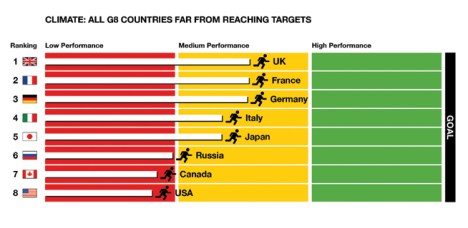
I forget where I heard that quote but if you haven’t guessed it relates to the G8’s “decision” not to allow an increase in global temp of more than 2C
This is dumb because it implies that we have a lot more control over global climate than we do.
Yes reducing carbon emissions would help the planet get back to an equilibrium but whether we can actually stop the current trends initiated more than two hundred years ago is a different question.
It is arrogant to state we have this much control over nature and stupid to assume that we know what will happen as temperatures rise.
Take sea level rise for example, IT IS NOT HAPPENING. This is not to say we shouldn’t reduce emissions and be clean for the future, just that symbolic goals without any reason to believe we can accomplish them doesn’t seem like the most effective way to change things.
…Particularly not when developing countries (ie the majority of the world) refuse to abide by this “decision”
Filed under: Business, Environment, Global Warming, News | Tagged: Business, Conservation, Global Warming, Politics, Public Policy | Leave a comment »

Givens:
The Earth is a closed system exposed to radiation.
A Basic Explanation of Chaos Theory: This is a mathematical theorem that attempts to predict the behavior (results) of complex systems. The result (answer) is K, which is a range of values not an actual number. The greater the number of variables, the larger the value of K. In a system with an infinite number of variables or a system where a large proportion of the variables are unknown, K is also undefinable.
Chaos Theory is the backbone of climate modeling.
Preliminary Conclusions:
Climate Modeling is inherently inaccurate because the unknown variables are too many.
-The chemical composition of the Earth is drastically different than it has ever been before due to our proliferation of heavy elements.
–This means that models based on historical climate change are also invalid.
Hypothesis:
The equilibrium of the planet has been thrown out of balance due to human activity.
The system has had significant additional work done on it by human industrial and population growth, increasing the internal energy and entropy.
The accumulation of heavy elements in the atmosphere has caused a green house effect, whereby the system’s membrane has become less permeable in terms of heat transference while retaining the same degree of permeability in terms of ultraviolet radiation.
The One Conclusion:
The Earth is experiencing an increase in Heat and Entropy.
This does NOT mean anyone has any idea what will happen as a result, all we can do is takes informed steps to minimise the effects of the earth restoring it’s own equilibrium.

Filed under: Environment, Global Warming | Tagged: Global Warming, greenhouse effect, Public Policy | 3 Comments »
daily beast slate MIT New Scientist The GreenGrok Alternative energy news Treehugger Earth Climate Inhabitat Triple Pundit RealClimate EcoGeek.org Earthfirst Earth2Tech The Good Human Cleantechnia Future Tech Good Clean Tech Huffy Celsias Expert Articles PhysOrg Mongabay


 GROG: green tech blog